
Keywords
How to Cite
Abstract
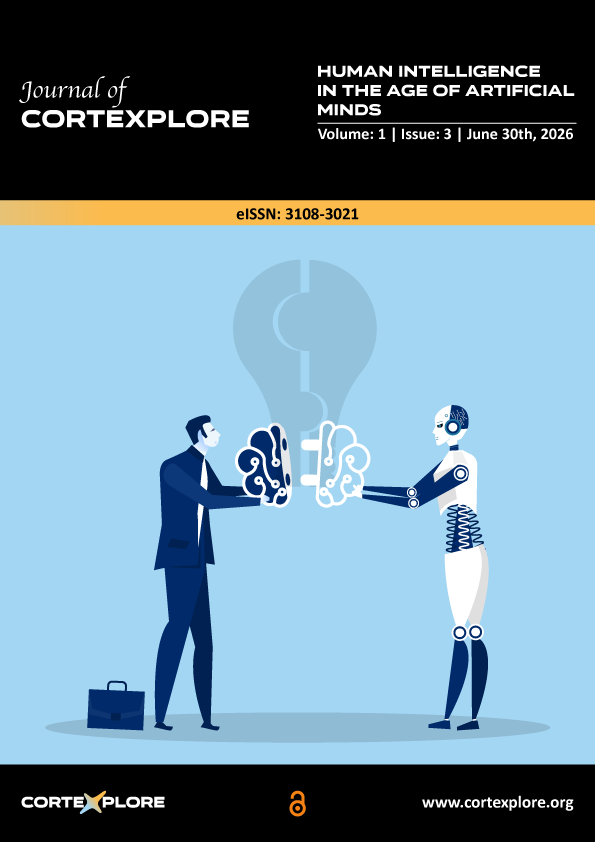
Artificial intelligence (AI) has evolved from a specific computational resource into an ever-expanding mental companion that influences human memory functions, learning processes, reasoning abilities, and decision-making methods. AI system implementation for daily operations and business activities has reached a level that requires scientists to analyse how this technology will influence human thinking abilities in future periods. The paper presents the Human–AI Cognitive Co-Adaptation Framework (HACCAF), which describes how human mental abilities and artificial intelligence systems develop through multiple interactions. The framework integrates cognitive offloading theory, cognitive demand theory, neuroplasticity theory, Human–AI symbiosis, and extended mind theory, drawing on research from cognitive psychology, neuroscience, and human–AI interaction studies. The analysis presents the Augmentation–Dependency Paradox, which demonstrates that AI technology produces opposite effects on human cognitive abilities because it intensifies mental functions while it makes people more dependent on technology. Using AI as a cognitive partner enables students to reflect, learn, and solve problems, leading to better cognitive flexibility, improved decision quality, and enhanced neuroplastic adaptation. The use of AI for memory functions and reasoning processes and judgment decisions at high levels would create mental dependence which would damage critical thinking abilities and decrease people's ability to monitor their own thinking processes. The framework presents nine theoretical propositions that exist within three separate domains: cognitive offloading, cognitive adaptation, and cognitive dependency. The study reveals essential factors that determine system boundaries, as well as elements that affect system performance, including AI literacy, user engagement, trust in AI, task complexity, and frequency of use. The paper presents cognitive co-adaptation as a continuous two-way process which establishes a common theoretical base between neuroscience and human–AI interaction research. The research study contributes to the emerging field of cognitive AI and workplace psychology by providing actionable knowledge that assists educators, organisations, technology designers, and policymakers in utilising AI for cognitive enhancement while avoiding dependence.
References
Afroogh, S., Akbari, A., Malone, E. et al. (2024). Trust in AI: progress, challenges, and future directions. Humanities and social sciences communications, 11, 1568. https://doi.org/10.1057/s41599-024-04044-8
Amershi, S., Weld, D., Vorvoreanu, M., Fourney, A., Nushi, B., Collisson, P., Suh, J., Iqbal, S., Bennett, P. N., Inkpen, K., Teevan, J., Kikin-Gil, R., & Horvitz, E. (2019). Guidelines for human–AI interaction. Proceedings of the 2019 CHI Conference on Human Factors in Computing Systems, 1–13. https://doi.org/10.1145/3290605.3300233
Azevedo, R., & Aleven, V. (Eds.). (2013). International handbook of metacognition and learning technologies. Springer. https://doi.org/10.1007/978-1-4419-5546-3
Barr, N., Pennycook, G., Stolz, J. A., & Fugelsang, J. A. (2015). The brain in your pocket: Evidence that smartphones are used to supplant thinking. Computers in Human Behavior, 48, 473–480. https://doi.org/10.1016/j.chb.2015.02.029
Bjork, E. L., & Bjork, R. A. (2011). Making things hard on yourself, but in a good way: Creating desirable difficulties to enhance learning. In M. A. Gernsbacher, R. W. Pew, L. M. Hough, & J. R. Pomerantz (Eds.), Psychology and the real world: Essays illustrating fundamental contributions to society (pp. 56–64). Worth Publishers. https://www.scirp.org/reference/referencespapers?referenceid=3200676 (Accessed on 05 June 2026).
Carr, N. (2020). The shallows: What the Internet is doing to our brains (2nd ed.). W. W. Norton & Company.
Clark, A., & Chalmers, D. J. (1998). The extended mind. Analysis, 58(1), 7–19. https://doi.org/10.1093/analys/58.1.7
Clark, A. (2008). Supersizing the mind: Embodiment, action, and cognitive extension. Philosophy of Mind Series (New York, 2008; online education, Oxford Academic, 1 Jan. 2009), https://doi.org/10.1093/acprof:oso/9780195333213.001.0001, accessed 2 June 2026.
Dellermann, D., Ebel, P., Söllner, M., & Leimeister, J. M. (2019). Hybrid intelligence. Business & Information Systems Engineering, 61(5), 637–643. https://doi.org/10.1007/s12599-019-00595-2
Dietvorst, B. J., Simmons, J. P., & Massey, C. (2015). Algorithm aversion: People erroneously avoid algorithms after seeing them err. Journal of Experimental Psychology: General, 144(1), 114–126. https://doi.org/10.1037/xge0000033
Endsley, M. R. (2016). From here to autonomy: Lessons learned from human–automation research. Human Factors; The Journal of the Human Factors and Ergonomics Society, 59(1), 5–27. https://doi.org/10.1177/0018720816681350
Einola, K., & Khoreva, V. (2023). Best friend or broken tool? Exploring the co-existence of humans and artificial intelligence in the workplace ecosystem. Human Resource Management, 62(1), 117–135. https://doi.org/10.1002/hrm.22147
Firth, J., Torous, J., Stubbs, B., Firth, J. A., Steiner, G. Z., Smith, L., Alvarez-Jimenez, M., Gleeson, J., Vancampfort, D., Armitage, C. J., & Sarris, J. (2019). The online brain: How the Internet may be changing our cognition. World Psychiatry, 18(2), 119–129. https://doi.org/10.1002/wps.20617
Goddard, K., Roudsari, A., & Wyatt, J. C. (2012). Automation bias: A systematic review of frequency, effect mediators, and mitigators. Journal of the American Medical Informatics Association, 19(1), 121–127. https://doi.org/10.1136/amiajnl-2011-000089
Gómez-Cruz, N. A., Rodríguez Castro, D. Y., Rey-Sarmiento, F., Zarate-Torres, R., & Moncada Niño, A. (2026). Mapping Human–AI Relationships: Intellectual Structure and Conceptual Insights. Technologies, 14(2), 83. https://doi.org/10.3390/technologies14020083
Jarrahi, M. H. (2018). Artificial intelligence and the future of work: Human–AI symbiosis in organizational decision making. Business Horizons, 61(4), 577–586. https://doi.org/10.1016/j.bushor.2018.03.007
Jiang, T., Sun, Z., Fu, S., & Lv, Y. (2024). Human-AI interaction research agenda: A user-centered perspective. Data and Information Management, 8(4), 100078. https://doi.org/10.1016/j.dim.2024.100078.
Krämer, W. Kahneman, D. (2011): Thinking, Fast and Slow. Stat Papers 55, 915 (2014). https://doi.org/10.1007/s00362-013-0533-y
Kim-Spoon, J., Deater-Deckard, K., Lauharatanahirun, N., Farley, J.P., Chiu, P.H., Bickel, W.K. and King-Casas, B. (2017), Neural Interaction Between Risk Sensitivity and Cognitive Control Predicting Health Risk Behaviors Among Late Adolescents. J Res Adolesc, 27: 674-682. https://doi.org/10.1111/jora.12295
Kolb, B., & Gibb, R. (2014). Searching for the principles of brain plasticity and behavior. Cortex, 58, 251–260. https://doi.org/10.1016/j.cortex.2013.11.012
Lee, J. D., & See, K. A. (2004). Trust in Automation: Designing for Appropriate Reliance. Human Factors: The Journal of the Human Factors and Ergonomics Society, 46(1), 50-80. https://doi.org/10.1518/hfes.46.1.50_30392 (accessed on 05 June 2026). Available at - https://journals.sagepub.com/doi/10.1518/hfes.46.1.50_30392
Loh, K. K., & Kanai, R. (2016). How has the Internet reshaped human cognition? The Neuroscientist, 22(5), 506–520. https://doi.org/10.1177/1073858415595005
Long, D., & Magerko, B. (2020). What is AI literacy? Competencies and design considerations. Proceedings of the 2020 CHI Conference on Human Factors in Computing Systems, 1–16. https://doi.org/10.1145/3313831.3376727
Maples, B., Cerit, M., Vishwanath, A. & Peck, K. M. (2025). How AI Companions shape learner’s socio-emotional learning and metacognitive development. AI & Society. https://doi.org/10.1007/s00146-025-02737-5
May, A. (2011). Experience-dependent structural plasticity in the adult human brain. Trends in Cognitive Sciences, 15(10), 475–482. https://doi.org/10.1016/j.tics.2011.08.002
Montealegre-López, N. (2025). Exploring the role of trust in AI-driven decision-making: a systematic literature review. Management Review Quarterly. https://doi.org/10.1007/s11301-025-00526-4
Ng, D. T. K., Leung, J. K. L., Chu, K. W. S., & Qiao, M. S. (2021). AI literacy: Definition, teaching, evaluation and ethical issues. Proceedings of the Association for Information Science and Technology, 58(1), 504–509. https://doi.org/10.1002/pra2.487
Parasuraman, R., & Manzey, D. H. (2010). Complacency and bias in human use of automation: An attentional integration. Human Factors, 52(3), 381–410. https://doi.org/10.1177/0018720810376055
Parasuraman, R., & Riley, V. (1997). Humans and automation: Use, misuse, disuse, abuse. Human Factors; The Journal of the Human Factors and Ergonomics Society, 39(2), 230–253. https://doi.org/10.1518/001872097778543886
Rai, A., Constantinides, P., & Sarker, S. (2019). Editor’s Comments: Next-Generation Digital Platforms: Toward Human–AI Hybrids. MIS Quarterly, 43(1), iii–x. https://doi.org/10.25300/MISQ/2019/431E0
Raisch, S., & Krakowski, S. (2021). Artificial intelligence and management: The automation–augmentation paradox. Academy of Management Review, 46(1), 192–210. https://doi.org/10.5465/amr.2018.0072
Risko, E. F., & Gilbert, S. J. (2016). Cognitive offloading. Trends in Cognitive Sciences, 20(9), 676–688. https://doi.org/10.1016/j.tics.2016.07.002
Schraw, G., & Dennison, R. S. (1994). Assessing metacognitive awareness. Contemporary Educational Psychology, 19(4), 460–475. https://doi.org/10.1006/ceps.1994.1033
Seeber, I., Bittner, E., Briggs, R. O., De Vreede, T., De Vreede, G.-J., Elkins, A., Maier, R., Merz, A. B., Oeste-Reiß, S., Randrup, N., Schwabe, G., & Söllner, M. (2020). Machines as teammates: A research agenda on AI in team collaboration. Information & Management, 57(2), 103174. https://doi.org/10.1016/j.im.2019.103174
Shneiderman, B. (2020). Human-centered artificial intelligence: Reliable, safe and trustworthy. International Journal of Human–Computer Interaction, 36(6), 495–504. https://doi.org/10.1080/10447318.2020.1741118
Skitka, L. J., Mosier, K. L., & Burdick, M. D. (1999). Does automation bias decision-making? International Journal of Human–Computer Studies, 51(5), 991–1006. https://doi.org/10.1006/ijhc.1999.0252
Sparrow, B., Liu, J., & Wegner, D. M. (2011). Google effects on memory: Cognitive consequences of having information at our fingertips. Science, 333(6043), 776–778. https://doi.org/10.1126/science.1207745
Sweller, J. (1988). Cognitive load during problem solving: Effects on learning. Cognitive Science, 12(2), 257–285. https://doi.org/10.1207/s15516709cog1202_4
Ward, A. F., Duke, K., Gneezy, A., & Bos, M. W. (2017). Brain Drain: The mere presence of one’s own smartphone reduces available cognitive capacity. Journal of the Association for Consumer Research, 2(2), 140–154. https://doi.org/10.1086/691462
Wilmer, H. H., Sherman, L. E., & Chein, J. M. (2017). Smartphones and cognition: A review of research exploring the links between mobile technology habits and cognitive functioning. Frontiers in Psychology, 8, 605. https://doi.org/10.3389/fpsyg.2017.00605
Zimmerman, B. J., & Moylan, A. R. (2009). Self-Regulation: When Metacognition and Motivation Intersect. In Hacker, D.J., Dunlosky, J., & Graesser, A.C. (Eds.). (2009). Handbook of Metacognition in Education (1st ed.) (pp. 299-315). Routledge. https://doi.org/10.4324/9780203876428

This work is licensed under a Creative Commons Attribution 4.0 International License.
Copyright (c) 2026 Journal of Cortexplore